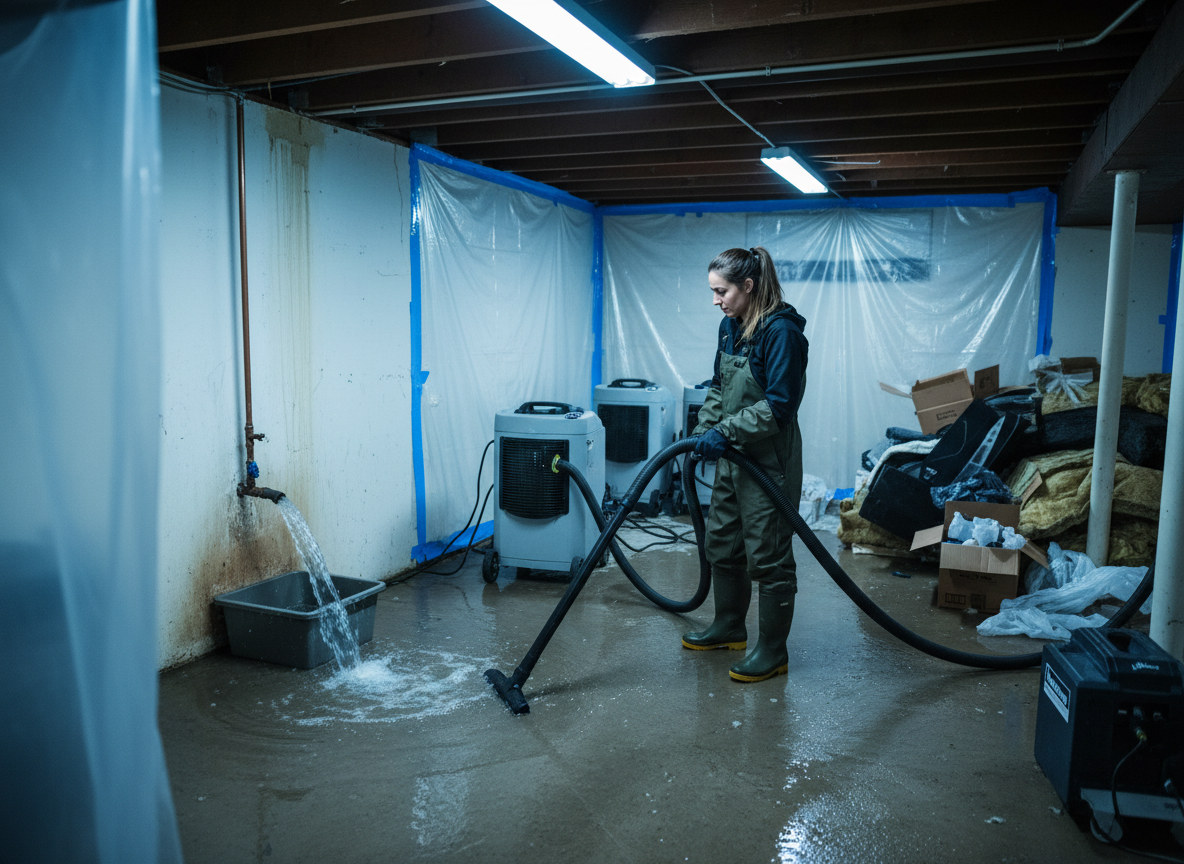
Waterloo's humid continental climate brings deep winter freezes that routinely split galvanized and copper lines in pre-1960 homes on the West Side and East Side. Once a pipe bursts, water migrates under oak hardwood floors and into plaster walls faster than most homeowners expect, especially in two-story houses near the Grout Museum District where basements sit close to the water table. Quick extraction within the first few hours limits secondary mold growth that thrives in the region's high summer humidity.
We map moisture with thermal imaging because Cedar Rapids and Cedar Falls border homes often have balloon framing that hides water behind exterior sheathing. Removing standing water alone is not enough; we pull baseboards, drill weep holes, and set up air movers pointed at subfloors to drive out trapped moisture before it reaches joists. Black Hawk County properties with clay-heavy soils drain slowly, so we monitor relative humidity for several days to confirm the structure is truly dry.
Edge cases include knob-and-tube wiring in Downtown rentals that cannot tolerate high-velocity drying without risk of shorting, and slab-on-grade homes near the Waterloo Center for the Arts where water travels under the slab and reappears days later. We isolate zones with plastic barriers and use low-grain dehumidifiers sized for the actual cubic footage rather than running oversized units that waste energy and disturb settled dust.
Homeowners sometimes attempt their own cleanup with box fans, but this spreads spores into HVAC systems common in 1950s West Side bungalows. Professional removal includes documenting affected materials for insurance adjusters and disposing of saturated insulation that cannot be salvaged under current Iowa moisture standards.
Technician insight
In Waterloo, the thing that catches most people out with Burst Pipe Water Removal is how quickly water travels under the hardwood in pre-war West Side homes once a main line freezes; the clay soil holds moisture against the foundation for days, so skipping the subfloor monitoring step almost always leads to hidden mold behind the baseboards.
West Side Bungalow Frozen Supply Line
A burst pipe under the kitchen floor sent water into the crawl space of a 1940s West Side home. We found saturation extending twelve feet into the living room subfloor and up two wall cavities. Extraction and directed drying over four days prevented mold from reaching the plaster; the homeowner kept the original oak floors.
Burst Pipe Water Removal Services We Offer
✓Emergency Water Extraction
Rapid pump-out and containment of standing water from burst pipes before it reaches finished basements in Waterloo's older stock.
✓Subfloor Drying and Moisture Mapping
Thermal imaging and targeted drying of hardwood and plywood subfloors common in East Side and Downtown homes after pipe failures.
✓Wall Cavity Drying
Removal of baseboards and installation of weep holes to dry plaster and lath walls without full demolition in Black Hawk County properties.
✓Frozen Pipe Burst Assessment
Inspection of supply lines in unheated crawl spaces and exterior walls after cold snaps that hit Cedar Falls border neighborhoods hardest.
✓HVAC Contamination Cleanup
Cleaning and sanitizing ductwork when burst water migrates into forced-air systems typical of 1950s West Side housing.
Burst Pipe Water Removal Cost in Waterloo, IA
| Service | Typical Range | What Affects It |
|---|---|---|
| Initial Assessment And Extraction | $250–$600 | Depends on volume of water and access in older homes |
| Full Room Drying Package | $800–$1,800 | Includes equipment for 3–5 days in typical Waterloo bungalow |
| Additional Level Or Basement | $350–$750 | Extra for multi-story or walk-out properties near the river |
| HVAC Cleaning Add-On | $400–$900 | When water reaches ductwork in forced-air homes |
Ranges are typical for Waterloo, IA and confirmed with an exact written quote before any work starts.
How it works
- 1
On-Site Assessment
We arrive with moisture meters and thermal cameras to locate all affected zones in the specific Waterloo neighborhood.
- 2
Water Removal
Pumps and wet vacuums extract standing water while protecting salvageable flooring and belongings.
- 3
Drying Setup
Air movers and dehumidifiers are placed according to the home's framing type and current outdoor humidity levels.
- 4
Final Verification
We recheck moisture readings across multiple days until levels match unaffected areas of the structure.
Pricing
Upfront quotes after inspection; price varies with square footage, depth of water, and number of affected levels.